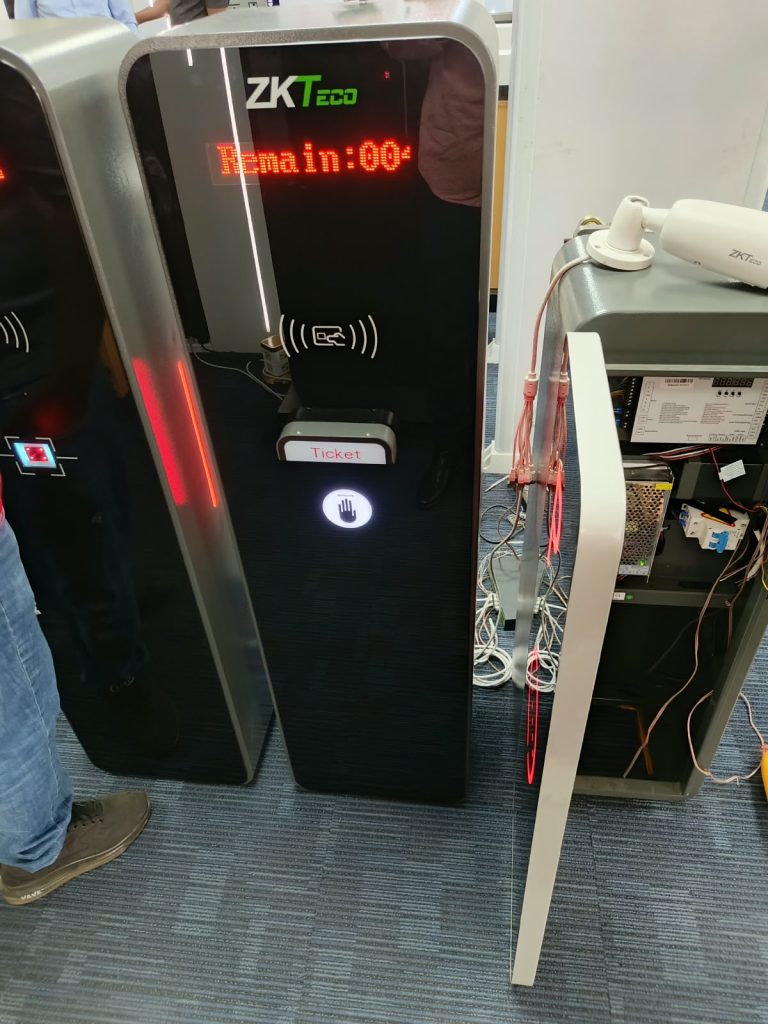
Parking Management Systems in Kenya: How to Choose the Right Parking, Vehicle Access and Security Solution
Parking Management Systems in Kenya: What Businesses Should Know Before Choosing an Installer.
Parking is no longer simply about putting a barrier at the entrance and giving drivers a ticket. For modern commercial buildings, residential developments, hospitals, hotels, shopping centres, offices, universities, industrial facilities, logistics sites and gated communities, parking is part of a wider security, access control, traffic management and vehicle-management system.
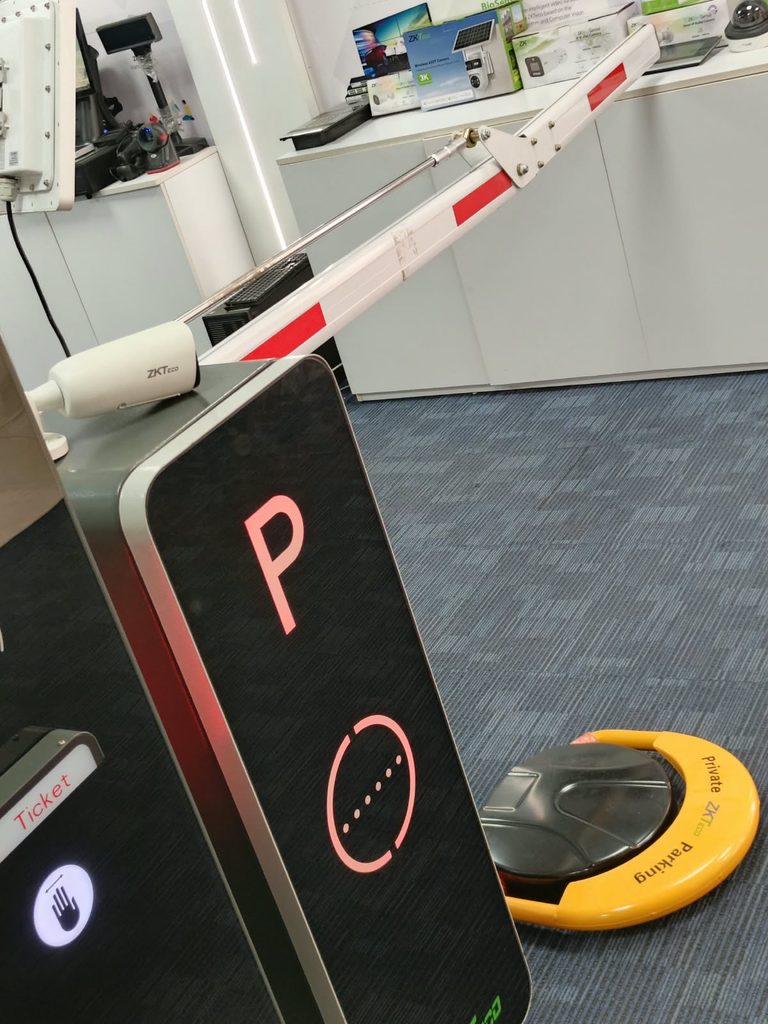
A properly designed parking system can help control vehicle entry and exit, identify vehicles, manage authorized users, monitor traffic, support visitor management and provide useful records for property and security management.
However, choosing the right parking solution requires more than selecting a parking barrier from a catalogue.
The barrier is only one part of the system.
A complete parking solution may involve automatic parking barriers, License Plate Recognition, UHF RFID vehicle identification, vehicle detection radar, loop detectors, ticket dispensers, parking locks, bollards, tyre killers, under-vehicle inspection systems, QR codes, barcodes and parking management software.
This is why technical knowledge and proper system design are important.
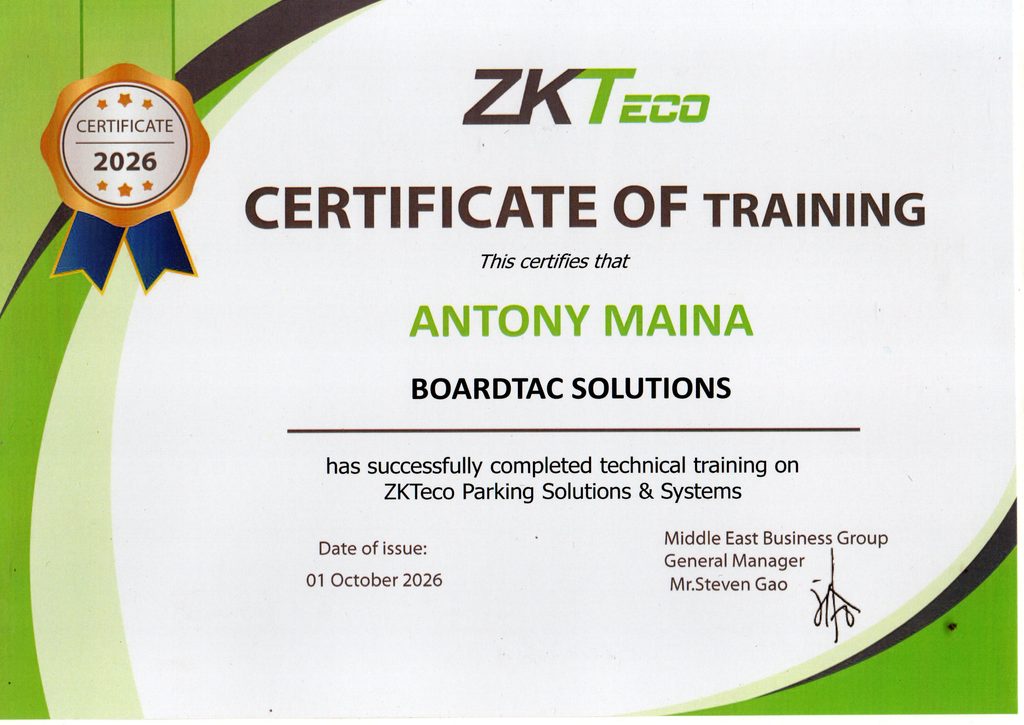
Boardtac Solutions has undertaken technical training in ZKTeco Parking Solutions & Systems, covering a broad range of parking and vehicle-management technologies. The training covered parking barriers, License Plate Recognition, UHF vehicle identification, vehicle detection, parking locks, vehicle security equipment, ticketing, under-vehicle inspection and parking monitoring concepts.
Boardtac has also researched how these technologies can be combined to address different parking, security and vehicle-access requirements. For reference, ZKTeco’s official parking product range includes parking barriers, License Plate Recognition, UHF readers, long-distance readers, ticket boxes, parking locks and parking-management software. (ZKTeco)
Helpful official resource: ZKTeco Parking and Vehicle Management Products
Why Choosing a Parking System Requires More Than Choosing a Barrier
A common mistake when planning a parking project is to start with the question:
“Which parking barrier should we buy?”
A better question is:
“What should happen when a vehicle arrives at the entrance?”
For example, consider a commercial building.
A vehicle arrives at the gate.
The system may need to determine:
- Is the vehicle authorised?
- Is the vehicle already registered?
- Should the number plate be captured?
- Should a UHF tag be read?
- Should the driver receive a ticket?
- Should security personnel approve the vehicle?
- Should the barrier open automatically?
- Should the vehicle movement be recorded?
- Should the vehicle be monitored when it exits?
- Should management be able to retrieve the vehicle’s entry and exit history?
These requirements determine the technology.
A parking barrier by itself cannot answer all of these questions.
This is why parking system design should come before equipment selection.
Boardtac Solutions and ZKTeco Parking Solutions Training
Boardtac Solutions has completed technical training in ZKTeco Parking Solutions & Systems.
The training covered a broad range of technologies used in modern parking and vehicle management, including:
- Parking barriers.
- License Plate Recognition.
- UHF RFID vehicle identification.
- Long-distance vehicle detection.
- Radar-based vehicle detection.
- Parking locks.
- Tyre killers.
- Security bollards.
- Under-vehicle inspection systems.
- Parking ticket dispensers.
- QR codes and barcodes.
- Loop detection.
- Vehicle sensors.
- Parking monitoring.
- Parking-management concepts.
The training included exposure to products and technologies such as:
- CMP200 Parking Barrier.
- BGM1000 Parking Barrier.
- ProBG3000 High-Performance Parking Barrier.
- ProBG8000 Series Parking Barrier.
- E-LPRC500 License Plate Recognition Camera.
- UHF5 Pro and UHF10 Pro UHF Readers.
- VR10 Pro Long-Distance Vehicle Reader.
- VR30 Long-Distance Vehicle Reader.
- Plock 2 Parking Lock.
- Tyre Killer Vehicle Security Equipment.
- Vehicle Security Bollards.
- ZK-VSCN100 Portable Under-Vehicle Scanning System.
- ZK-VSCN200 Flush-Mount Under-Vehicle Scanning System.
- TBM01/TBM02 Parking Ticket Boxes.
- ZKEasyGo and ZKTecoParking software.
ZKTeco’s current official parking product page confirms the product categories covering these technologies, including ProBG8000, BGM1000, CMP200, ProBG3000, E-LPRC500, UHF5 Pro and UHF10 Pro, VR30, VR10 Pro, TBM01/02, Plock 2 and parking software. (ZKTeco)
ZKTeco Official Parking Barrier and Vehicle Management Range
Understanding Automatic Parking Barriers
Automatic parking barriers are one of the most visible components of a parking system.
They control the physical movement of vehicles through an entrance or exit.
However, different sites have different traffic requirements.
A small residential development may not require the same barrier technology as a busy shopping centre, hospital, commercial building or industrial facility.
ZKTeco’s parking range includes the CMP200, BGM1000, ProBG3000 and ProBG8000. (ZKTeco)
The ProBG3000, for example, is described by ZKTeco as a high-performance, high-speed barrier gate using a servo motor and incorporating anti-collision protection. (ZKTeco)
The ProBG8000 Series is described by ZKTeco as a servo-driven parking barrier designed for high-intensity traffic environments. ZKTeco lists applications including shopping malls, commercial areas, residential apartments, factories, schools and hospitals. (ZKTeco)
ZKTeco ProBG3000 Parking Barrier
What should be considered when selecting a parking barrier?
Boardtac considers factors such as:
- Number of vehicles using the entrance.
- Traffic volume during peak periods.
- Number of entry and exit lanes.
- Required opening and closing speed.
- Boom-arm length.
- Entrance width.
- Indoor or outdoor installation.
- Vehicle direction.
- Safety requirements.
- Anti-collision requirements.
- Power availability.
- Emergency operation.
- Integration with access-control equipment.
- Integration with LPR or RFID.
- Future expansion.
This helps prevent the common mistake of selecting a barrier based only on price.
License Plate Recognition for Parking in Kenya
License Plate Recognition, commonly called LPR, is an important technology in modern parking systems.
Instead of requiring every vehicle to rely on a physical ticket or access card, an LPR system can identify vehicles by reading their registration plates.
This can be useful for:
- Staff parking.
- Residential apartments.
- Commercial buildings.
- Hotels.
- Hospitals.
- Shopping centres.
- Universities.
- Controlled compounds.
- Visitor management.
- Vehicle access records.
The E-LPRC500 License Plate Recognition Camera is specifically designed for applications including traffic management, security, parking, tolling and Intelligent Transport Systems. ZKTeco states that the camera is designed for vehicle and license-plate recognition. (ZKTeco)
ZKTeco E-LPRC500 License Plate Recognition Camera
LPR is not simply a CCTV camera
A proper LPR system requires consideration of:
- Camera position.
- Vehicle approach direction.
- Distance from the camera to the vehicle.
- Lane width.
- Vehicle speed.
- Lighting conditions.
- Day and night performance.
- Number-plate visibility.
- Camera angle.
- Barrier position.
- Network connectivity.
- Software integration.
- Database configuration.
Installing an ordinary CCTV camera and calling it an LPR system is not the same as designing a proper License Plate Recognition solution.
Boardtac’s approach is to consider the complete vehicle-access workflow before selecting the equipment.
UHF RFID Vehicle Identification
Some parking environments require vehicles to be identified without stopping to present a card or ticket.
This is where UHF RFID vehicle identification can be useful.
ZKTeco’s UHF5 Pro and UHF10 Pro are UHF readers designed for Vehicle Management and Personnel Management applications. ZKTeco states that they support passive UHF cards, multiple communication interfaces including Wiegand and RS485, and IP66 protection. (ZKTeco)
UHF RFID can be considered for:
- Staff parking.
- Residential parking.
- Corporate compounds.
- Industrial facilities.
- Logistics facilities.
- Restricted vehicle areas.
- Fleet access.
- Long-term parking users.
The important question is not simply whether UHF works.
The question is whether UHF is appropriate for the particular site.
Boardtac can assess traffic flow, vehicle types, access requirements and the desired level of automation before recommending the technology.
Vehicle Detection: Radar, Loop Detectors and Sensors
Vehicle detection is a major part of an automated parking system.
The system needs to know when a vehicle is approaching, when it is under the barrier and, in some cases, whether a vehicle is still occupying the lane.
Different technologies can be used.
Radar vehicle detection
ZKTeco lists the VR10 Pro and VR30 under its Long Distance Reader category. (ZKTeco)
Radar-based detection can be considered where the project requires contactless vehicle detection and where civil works for road loops may not be desirable.
Loop detection
A loop detector normally uses a detection loop installed in or beneath the road surface.
When a suitable vehicle enters the detection area, the system detects the change and can trigger a connected controller.
Loop detection can be useful for:
- Barrier safety.
- Vehicle presence detection.
- Automatic barrier control.
- Preventing the barrier from closing onto a vehicle.
- Traffic sequencing.
ZKTeco’s parking barrier specifications also identify loop detection as one of the technologies used within parking-barrier applications. (ZKTeco)
Sensors
Other sensor technologies may also be used depending on the application.
The correct detection technology depends on:
- Existing road conditions.
- Civil works.
- Traffic volume.
- Required detection distance.
- Environmental conditions.
- Vehicle type.
- Barrier configuration.
- Safety requirements.
Boardtac’s approach is to select the detection method as part of the overall parking-system design.
Parking Ticket Systems
Not every parking facility needs fully automated LPR or RFID.
Some environments still benefit from a ticket-based system.
ZKTeco includes TBM01/TBM02 Parking Ticket Boxes within its parking product range. (ZKTeco)
Ticketing can be considered for:
- Shopping centres.
- Public parking facilities.
- Hospitals.
- Hotels.
- Commercial buildings.
- Temporary parking.
- Visitor parking.
- Facilities where users do not have registered vehicle identities.
A typical workflow could be:
Vehicle arrives → vehicle detected → ticket issued → barrier opens → vehicle enters → ticket used during exit → ticket validated → exit authorised → barrier opens.
The exact workflow depends on the parking-management system and site requirements.
QR Codes and Barcodes in Parking Systems
QR codes and barcodes can also play a role in parking management.
They may be used for:
- Visitor access.
- Temporary parking.
- Digital permits.
- Ticket validation.
- Event parking.
- Short-term access.
- Access confirmation.
- Vehicle or user identification.
A QR-based system can be useful where an operator wants to avoid issuing physical cards for every temporary visitor.
However, QR codes are not automatically the right choice for every site.
The choice between QR codes, barcodes, RFID, UHF RFID, LPR or another identification method should depend on how the parking facility operates.
Parking Locks for Reserved Parking Spaces
Parking management is not only about entrances and exits.
Some properties need to control individual parking bays.
For example, an apartment owner may have an assigned parking space that should not be occupied by another vehicle.
This is where parking locks can be considered.
ZKTeco includes Plock 2 Parking Lock within its parking product range. (ZKTeco)
Parking locks can be considered for:
- Residential apartments.
- Private parking bays.
- Reserved corporate parking.
- VIP parking.
- Restricted parking spaces.
- Property-management applications.
Bollards and Tyre Killers
Some sites require more than a normal parking barrier.
Security bollards can be used to control or restrict vehicle movement at specific points.
Tyre killers can provide another form of vehicle-security control where the objective is to restrict unauthorised vehicles from passing through a controlled lane.
These technologies can be considered for:
- High-security compounds.
- Restricted vehicle entrances.
- Industrial facilities.
- Critical infrastructure.
- Controlled service entrances.
The design should consider vehicle direction, emergency access, authorised traffic flow and the consequences of incorrect operation.
Under-Vehicle Inspection Systems
Some facilities require a higher level of vehicle security.
An under-vehicle inspection system allows security personnel to inspect the underside of vehicles for objects or items that may not be visible through normal inspection.
ZK-VSCN100 Portable Under-Vehicle Scanning System
ZKTeco describes the ZK-VSCN100 as a portable under-vehicle scanning system designed for checkpoints that need mobility or locations where the road cannot be excavated. The system uses high-speed line-scan CCD imaging and generates images of the vehicle undercarriage as the vehicle passes. (ZKTeco)
ZKTeco ZK-VSCN100 Portable Under-Vehicle Scanning System
ZK-VSCN200 Flush-Mount Under-Vehicle Scanning System
The ZK-VSCN200 is a flush-mount under-vehicle scanning system. ZKTeco states that it uses high-speed line-scan CCD technology and can capture high-resolution undercarriage images as vehicles pass through. It can also integrate with surveillance cameras and License Plate Recognition systems. (ZKTeco)
ZKTeco ZK-VSCN200 Flush-Mount Under-Vehicle Scanning System
This type of technology can be considered for:
- High-security compounds.
- Government facilities.
- Banks.
- Customs facilities.
- Industrial sites.
- Critical infrastructure.
- Secure logistics environments.
- Controlled vehicle entrances.
Parking Monitoring and Management
A modern parking system should provide more than physical access control.
Management may need information about:
- Vehicle entries.
- Vehicle exits.
- Registered vehicles.
- Visitor vehicles.
- Staff vehicles.
- Parking duration.
- Access events.
- Exceptions.
- Authorised vehicles.
- System alarms.
- Equipment status.
This is why parking-management software is important.
ZKTeco’s current parking product range includes ZKEasyGo and ZKTecoParking software alongside its parking barriers, LPR, UHF readers, long-distance readers, ticket boxes and parking locks. (ZKTeco)
ZKTeco Parking Product Range and Software
Boardtac’s training therefore extends beyond the physical barrier and considers the wider relationship between identification, detection, access control, parking management and monitoring.
Choosing Between LPR, UHF RFID, QR Codes and Tickets
One of the most important decisions in parking-system design is selecting the correct vehicle-identification method.
There is no single technology that is appropriate for every Kenyan parking facility.
| Technology | Typical application |
|---|---|
| License Plate Recognition | Vehicle identification using registration plates |
| UHF RFID | Registered vehicles requiring longer-range identification |
| QR Code | Visitors, temporary users and digital permits |
| Barcode | Ticketing and controlled parking workflows |
| Parking Ticket | Public and temporary parking |
| Access Card | Registered users and controlled access |
| Manual Verification | Sites where security approval is required |
The correct system may also combine several technologies.
For example:
LPR + UHF RFID + parking barrier + radar detection + parking management software.
Another site may require:
Ticket dispenser + barcode reader + loop detector + parking barrier + parking-management software.
The correct combination depends on the site.
Why Site Assessment Matters in Kenya
Kenyan parking facilities vary considerably.
A parking system for a Nairobi office building may have different requirements from a residential apartment, shopping centre, hospital, industrial facility or logistics yard.
Before recommending equipment, Boardtac considers factors such as:
Traffic volume
How many vehicles enter and leave during normal and peak periods?
Number of lanes
Is there one entry and one exit, or multiple lanes?
Vehicle types
Does the site handle private cars, SUVs, vans, trucks, buses or motorcycles?
Entry and exit layout
Is there enough space for vehicles to queue safely?
Existing infrastructure
What power, network, CCTV, access-control and civil infrastructure already exists?
Security requirements
Does the client need basic access control or detailed vehicle identification and monitoring?
User types
Are there staff, residents, visitors, customers, contractors and delivery vehicles?
Parking duration
Is the parking short-term, long-term, reserved or mixed?
Identification method
Should vehicles be identified using LPR, UHF RFID, QR codes, cards, tickets or manual verification?
Future expansion
Can the system accommodate additional lanes, parking areas, users or technologies later?
Parking Solutions for Different Kenyan Businesses
Residential Apartments
Apartment developments may require:
- Resident vehicle registration.
- LPR.
- UHF RFID.
- Visitor management.
- Parking barriers.
- Parking locks.
- CCTV integration.
- Access records.
The objective is usually to provide residents with convenient access while maintaining control over visitors and unauthorised vehicles.
Commercial Buildings
Office buildings may require:
- Staff vehicle identification.
- Visitor parking.
- LPR.
- UHF RFID.
- Parking barriers.
- QR-based visitor access.
- Parking monitoring.
- Multiple access levels.
Shopping Centres
Shopping centres may require:
- High-volume parking management.
- Ticketing.
- Barcode or QR-based workflows.
- LPR.
- Multiple entry and exit lanes.
- Parking monitoring.
- Vehicle detection.
- Barrier automation.
The system needs to be designed around customer flow and peak traffic.
Hotels
Hotels may need:
- Guest vehicle identification.
- Visitor parking.
- Staff parking.
- LPR.
- QR-based access.
- Ticketing.
- Parking monitoring.
Hospitals
Hospitals can have several vehicle categories, including:
- Patients.
- Visitors.
- Doctors.
- Nurses.
- Staff.
- Ambulances.
- Suppliers.
- Service vehicles.
A parking system can therefore be designed with different access rules for different users.
Logistics and Industrial Facilities
Industrial and logistics facilities may require stronger vehicle-security controls.
Depending on the site, the system can incorporate:
- LPR.
- UHF RFID.
- Parking barriers.
- Vehicle detection.
- Bollards.
- Tyre killers.
- Under-vehicle inspection.
- CCTV.
- Vehicle records.
Why Boardtac’s Technical Training Matters
When selecting a parking-system installer, it is useful to look beyond whether the installer can physically mount a barrier.
The installer should understand why a particular technology is being selected.
Boardtac’s ZKTeco parking training covered multiple technologies rather than focusing on only one product category.
This includes understanding the role of:
- Parking barriers.
- License Plate Recognition.
- UHF RFID.
- Long-distance vehicle detection.
- Radar.
- Parking locks.
- Ticketing.
- Vehicle security.
- Under-vehicle inspection.
- Vehicle detection.
- QR codes.
- Barcodes.
- Parking monitoring.
This broader technical exposure allows Boardtac to approach a parking project as a complete system-design exercise.
Boardtac’s Approach to Parking System Design
A typical Boardtac parking project can be approached through several stages.
Step 1: Understand the site
The first step is to understand the property, traffic flow, users and security requirements.
Step 2: Assess the entrance and exit
The physical layout is reviewed to determine the appropriate position for barriers, cameras, readers, detectors and other equipment.
Step 3: Identify the vehicle-management requirement
The system may require LPR, UHF RFID, QR codes, tickets, cards or a combination.
Step 4: Select the vehicle-detection method
Depending on the site, detection may use radar, loop detectors, sensors or another suitable technology.
Step 5: Select the barrier
The barrier should match the traffic volume, lane configuration, boom length, operating speed and security requirements.
Step 6: Consider additional security
Where necessary, the design can incorporate bollards, tyre killers, parking locks or under-vehicle inspection.
Step 7: Design monitoring and management
The client should be able to manage the system according to the required operational workflow.
Step 8: Plan networking and power
Reliable parking systems depend on suitable power, communication and network infrastructure.
Step 9: Configure and test
Equipment should be configured and tested as a complete system rather than tested only as individual devices.
Step 10: Handover and support
The client should understand how the system works and how to manage normal operations and common issues.
What Makes a Good Parking System?
A good parking system should bring together several elements.
Vehicle identification: Who or what is the vehicle?
Vehicle detection: Where is the vehicle?
Access control: Should the vehicle be allowed through?
Physical control: How is the vehicle physically stopped or permitted to pass?
Monitoring: What happened during the access event?
Management: How does the operator manage users, vehicles and parking operations?
Security: What additional measures are needed to protect the property?
Reliability: Can the system operate under the expected traffic and environmental conditions?
This systems-based approach is what separates parking equipment installation from parking system design and implementation.
Why Kenyan Businesses Can Consider Boardtac Solutions
Boardtac Solutions brings together practical security-system experience, technical training and ongoing product research.
The ZKTeco parking training adds knowledge in areas directly relevant to modern vehicle-management projects.
This includes:
- Automatic parking barriers.
- License Plate Recognition.
- UHF RFID.
- Vehicle detection radar.
- Loop detectors.
- Parking sensors.
- Parking ticket dispensers.
- QR codes.
- Barcodes.
- Parking locks.
- Bollards.
- Tyre killers.
- Under-vehicle inspection systems.
- Parking monitoring.
- Parking-management software.
This allows Boardtac to look at the complete parking environment, rather than recommending a single device without considering how the rest of the system will operate.
Frequently Asked Questions About Parking Management Systems in Kenya
What is a parking management system?
A parking management system is a combination of hardware and software used to control, monitor and manage vehicles entering, leaving and using a parking facility.
It may include barriers, LPR cameras, RFID readers, vehicle detection, ticketing equipment, parking locks, security equipment and management software.
What is the best parking system for a Kenyan business?
The appropriate parking system depends on the site’s traffic volume, layout, users, security requirements, budget, infrastructure and desired level of automation.
There is no single parking technology suitable for every property.
Can Boardtac install automatic parking barriers in Kenya?
Boardtac Solutions provides security and access-control solutions and has undertaken technical training covering ZKTeco parking solutions and systems. Parking-barrier selection should be based on the site’s traffic, lane configuration, security requirements and integration needs.
Can LPR be used for parking in Kenya?
Yes. License Plate Recognition can be used as part of a vehicle-access and parking-management system. The design should consider camera positioning, lighting, vehicle speed, plate visibility, network connectivity and software integration.
Can LPR and UHF RFID be used together?
Yes. They can serve different purposes within the same parking system. LPR can identify vehicles using their registration plates, while UHF RFID can identify registered vehicles carrying compatible tags.
Can parking systems use QR codes?
Yes. QR codes can be used for visitor access, temporary parking, digital permits and other controlled-access workflows.
What is the difference between LPR and UHF RFID?
LPR identifies a vehicle using its registration plate. UHF RFID identifies a vehicle or authorised user through a compatible RFID tag. The appropriate technology depends on the site’s operating requirements.
What is a vehicle detection radar?
A vehicle-detection radar detects vehicles without requiring physical contact with the vehicle. It can be used as part of automated parking and barrier-control systems.
What is a loop detector?
A loop detector uses a detection loop installed in the vehicle lane to detect the presence of a vehicle. It can be used for barrier control and vehicle safety.
What is an under-vehicle inspection system?
An under-vehicle inspection system captures images of the underside of a vehicle to help security personnel inspect for objects or items that may be attached underneath the vehicle.
Can parking systems be integrated with CCTV?
Yes. Parking systems can be designed alongside CCTV and other security systems so that vehicle movements and security events can be monitored together, depending on the selected equipment and integration requirements.
Choose the Parking System Based on the Problem, Not Just the Product
The most important principle in parking-system design is simple:
Do not start with the product. Start with the problem.
If the problem is unauthorised vehicles, the solution may involve LPR, UHF RFID or another identification method.
If the problem is uncontrolled vehicle movement, a parking barrier may be required.
If the problem is vehicle detection, radar or loop detection may be appropriate.
If the problem is reserved parking, parking locks may be considered.
If the problem is high-security vehicle entry, bollards, tyre killers or under-vehicle inspection may form part of the solution.
If the facility is public or short-term parking, ticketing, QR codes or barcode-based systems may be more appropriate.
In many cases, the best solution is a combination of several technologies.
Talk to Boardtac Solutions About Your Parking Project
Choosing a parking management system is an investment in security, access control, traffic management and operational efficiency.
Boardtac Solutions can assess the requirements of your site and help determine the appropriate combination of parking barriers, vehicle identification, vehicle detection, ticketing, parking security and monitoring technologies.
Our technical training in ZKTeco Parking Solutions & Systems, combined with ongoing research into parking and vehicle-management technologies, gives Boardtac a broader understanding of the equipment and technologies used in modern parking environments.
Whether you are planning a parking system for an apartment, office building, shopping centre, hospital, hotel, school, university, industrial facility, logistics site, gated community or commercial property, the system should be designed around the way your site actually operates.
Boardtac Solutions can help you assess the requirement, design the appropriate system and provide the equipment, installation, configuration, testing and technical support required for the project.
Call Boardtac Solutions on 011-367-0045, email support@boardtac.co.ke, or visit Boardtac Solutions to request a consultation or quotation.
Helpful ZKTeco Resources
For clients who want to learn more about the technologies discussed in this article, the following are useful official ZKTeco resources:
- ZKTeco Parking Barrier and Vehicle Management Products — Covers parking barriers, LPR, UHF readers, long-distance readers, ticket boxes, parking locks and parking software. (ZKTeco)
- ZKTeco Parking Barriers — Product information covering the parking-barrier range. (ZKTeco)
- ZKTeco E-LPRC500 — Official information about License Plate Recognition technology. (ZKTeco)
- ZKTeco UHF5 Pro and UHF10 Pro — Official information about UHF readers for vehicle and personnel management. (ZKTeco)
- ZKTeco ZK-VSCN100 — Portable under-vehicle inspection system. (ZKTeco)
- ZKTeco ZK-VSCN200 — Flush-mount under-vehicle inspection system. (ZKTeco)
- ZKTeco ProBG3000 — High-performance parking barrier information. (ZKTeco)