Hospital CCTV Installation in Nairobi: How to Secure Gates, Parking Areas and Eliminate Blind Spots
A hospital is more than a building. It is a busy environment where patients, doctors, nurses, visitors, vehicles, suppliers, security teams and service providers move in and out every day. Because hospitals operate around the clock, CCTV security must also be designed for continuous operation. A poorly positioned camera can leave a critical area unprotected even when the property appears to have many cameras. This is why professional CCTV installation is not simply about buying cameras and mounting them on walls.

It is about understanding the risks, identifying blind spots, selecting the correct cameras, positioning them correctly, providing strong mounting structures, considering lighting conditions, protecting cables, testing the final views and ensuring that the system produces useful footage when an incident occurs. At Boardtac Solutions, we approach CCTV installation with this principle in mind.
A CCTV system should be designed around the security risk, not simply around the number of cameras being installed.
A Real CCTV Security Challenge at a Nairobi Hospital
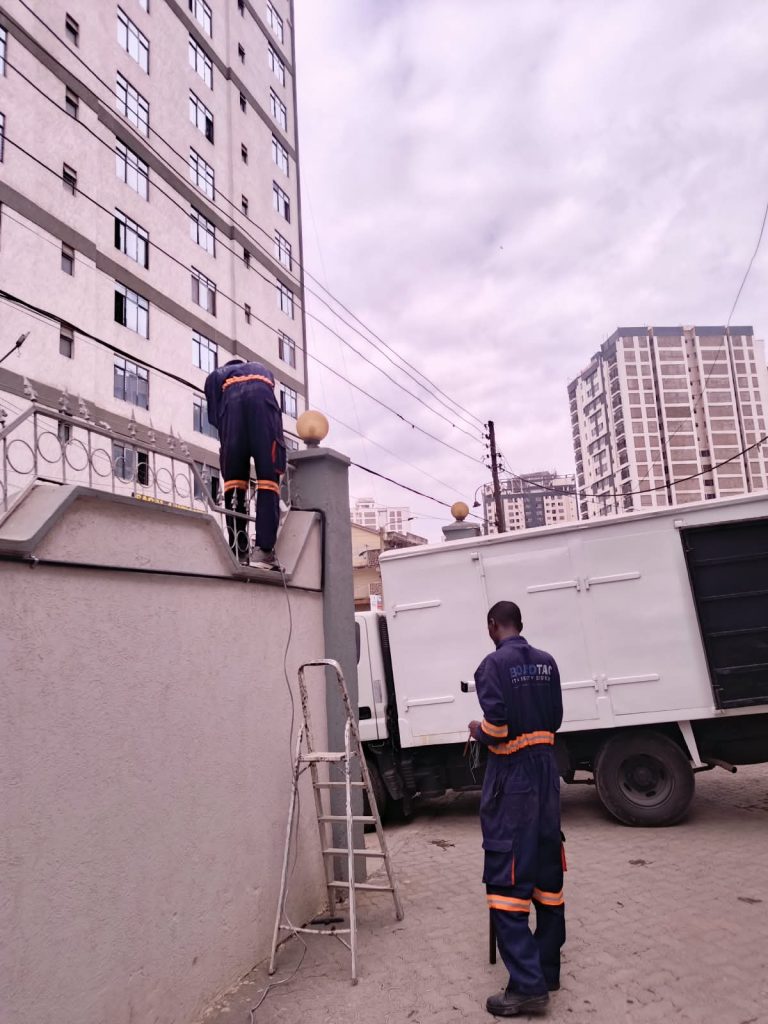
Boardtac Solutions was called by a prominent hospital in Nairobi after a security concern was identified around the hospital’s outside gate and parking area.
The hospital had identified a blind spot affecting part of the external parking area and the gate.
This was particularly important because vehicles were being left in the parking area, and car parts were being vandalized while vehicles were parked.
The problem was not simply that the hospital needed more cameras.
The real problem was that the existing camera coverage did not provide the level of visibility required for the particular risk area.
This is an important lesson for businesses, hospitals, apartment buildings, schools, warehouses and other properties.
Having CCTV cameras does not automatically mean that a property is properly covered.
A camera may be recording continuously but still fail to capture the face of a person, the movement of a vehicle, a number plate or the activity taking place in a particular blind spot.
How Boardtac Approached the Hospital CCTV Blind Spot
Boardtac Solutions assessed the area and considered how people and vehicles were moving through the gate and parking area.
Instead of simply placing another camera somewhere on the existing building, the CCTV coverage was planned around the actual area that needed protection.
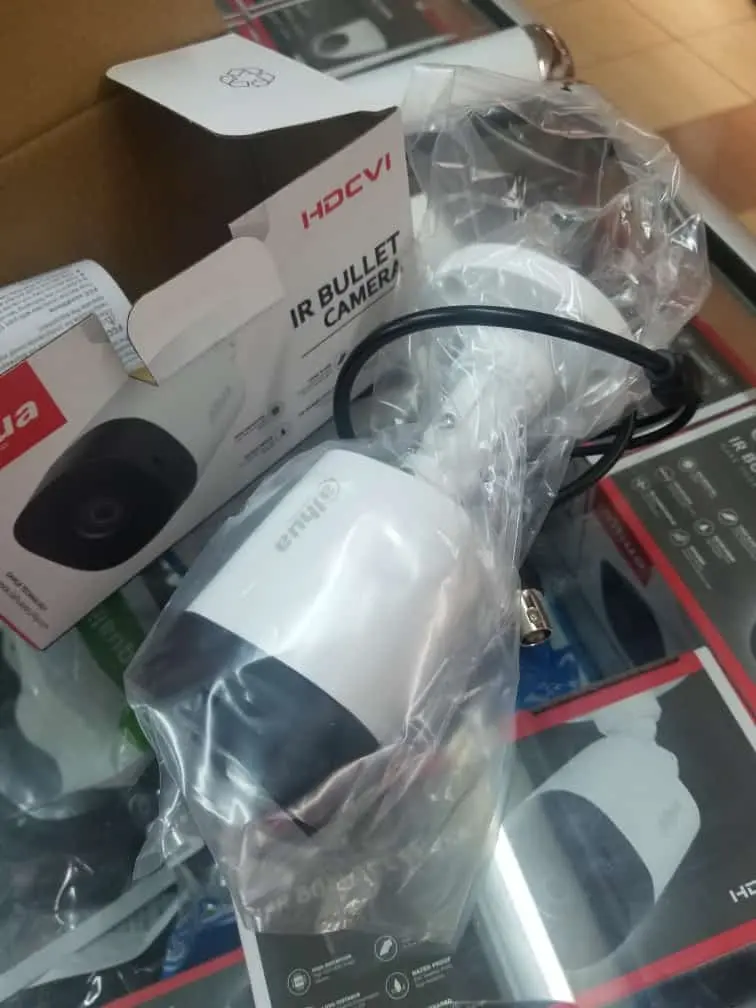
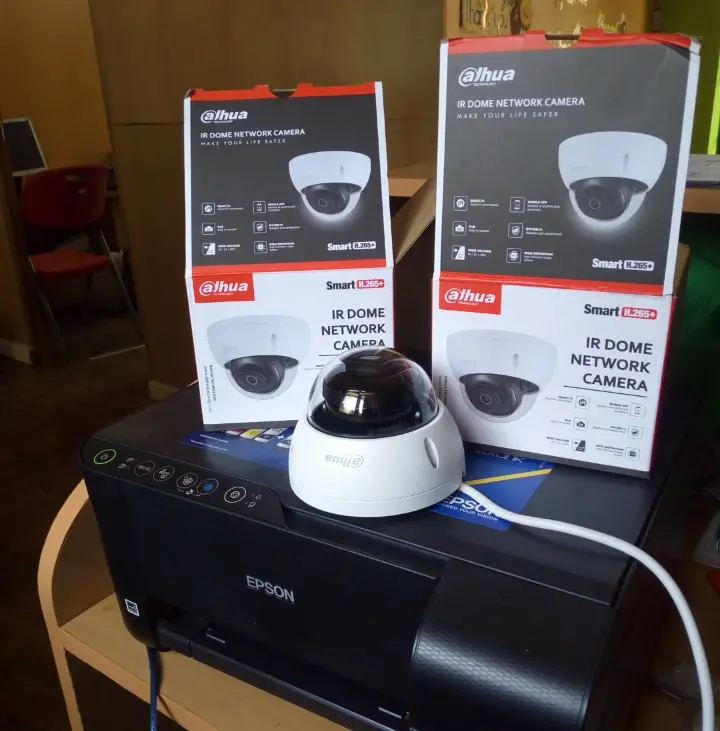
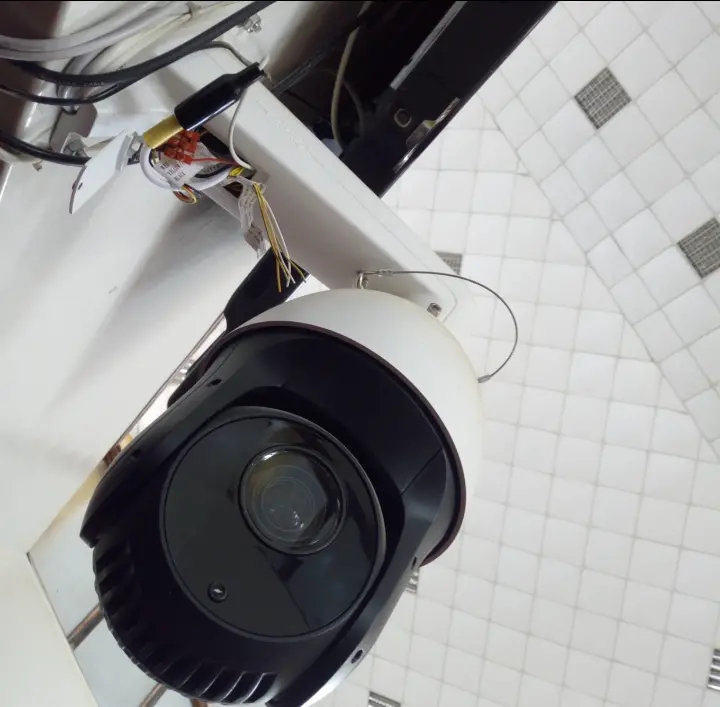
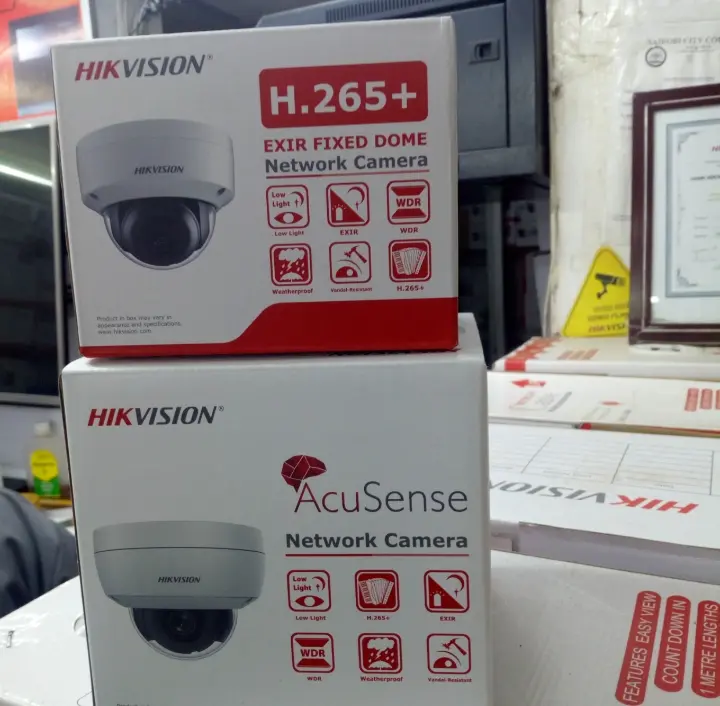
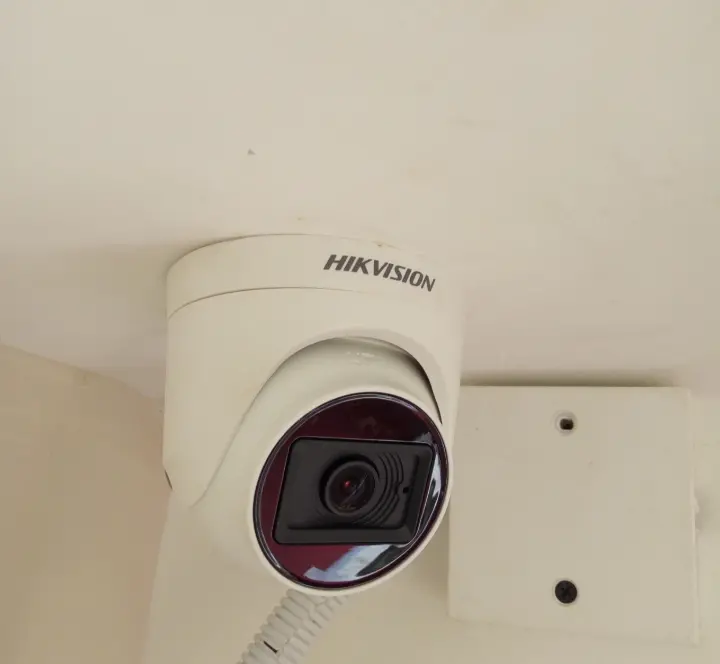
Specialized cameras were selected for the application.
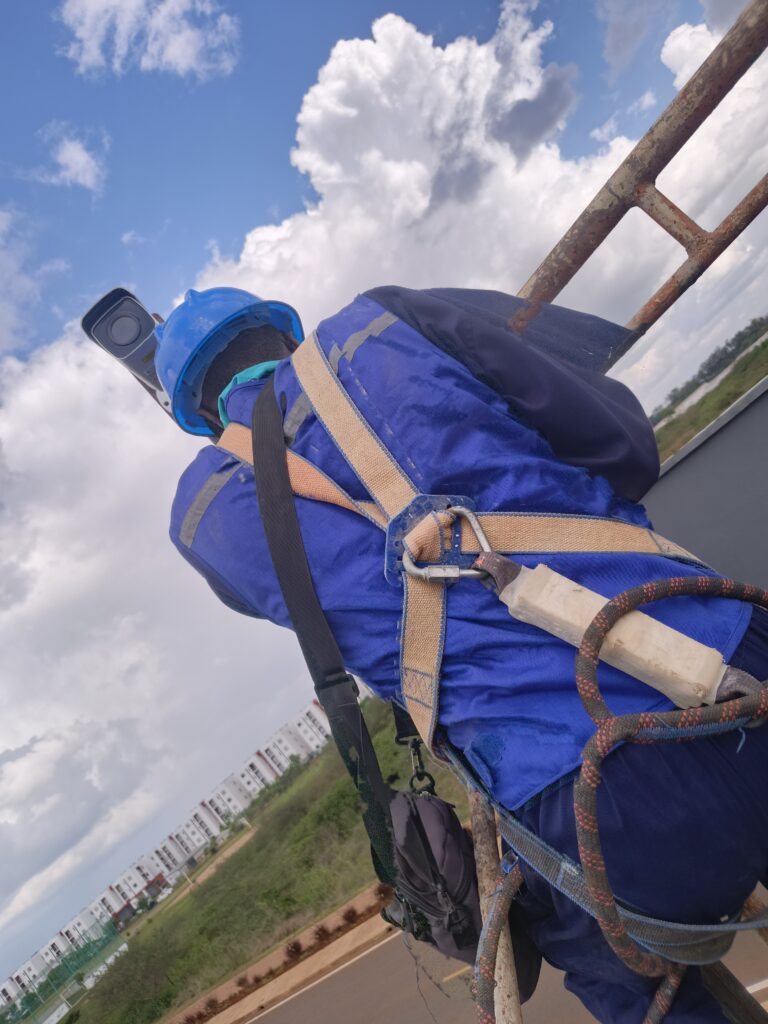
We then strategically installed CCTV metal stand posts on either side of the gate. The posts were securely welded to provide stable mounting points for the cameras and to allow the cameras to cover the respective sides of the gate effectively.
This approach provided a more controlled camera position than simply mounting cameras wherever a convenient wall or structure was available.
The objective was to create effective visibility of the gate and the surrounding parking area while reducing the previously identified blind spot.
The installation demonstrates an important principle of professional CCTV work.
Camera positioning should follow the security objective. The security objective should not follow the easiest place to mount a camera.
Why CCTV Blind Spots Are a Serious Problem
A blind spot is an area that cannot be properly observed by the CCTV system.
Blind spots can occur because of buildings, walls, gates, pillars, parked vehicles, landscaping, poor camera angles, inadequate lighting or simply because the original CCTV system was not designed around the actual movement of people and vehicles.
In a hospital, a blind spot around a parking area can become particularly important.
A person may approach a vehicle from an angle that the camera cannot see.
A vehicle may enter or leave without its number plate being captured clearly.
A person may move between two areas without appearing clearly on any camera.
An incident may therefore occur even though the property has a CCTV system.
Professional CCTV design attempts to reduce these gaps by studying the property before deciding where cameras should be installed. Healthcare CCTV guidance also emphasizes risk assessment, strategic coverage and minimizing blind spots, while recognizing that complete coverage can be affected by building geometry and obstacles.
How Should CCTV Cameras Be Installed at a Hospital Gate?
The main gate is one of the most important CCTV locations at a hospital.
It is where vehicles and people enter and leave the property.
A properly designed gate surveillance system should consider several different security requirements.
1. Cover the entrance and exit movement
The camera should be positioned to observe the movement of vehicles and people entering and leaving.
Where there are separate entry and exit lanes, the CCTV design should consider each movement path individually.
The goal is not simply to see that a vehicle passed through the gate.
The system should provide useful evidence that can assist in identifying what happened.
2. Consider vehicle identification
Where vehicle identification is important, a camera should be selected and positioned specifically for that purpose.
A general wide-angle camera may provide an excellent overview of a gate but may not provide the best image for reading a number plate.
For this reason, larger properties may require different camera views for different purposes.
One camera may provide the overall scene.
Another may provide a more focused view of vehicles.
Another may monitor pedestrians or the security checkpoint.
3. Avoid positioning cameras directly into difficult lighting
Gates can experience strong sunlight during the day and vehicle headlights at night.
If a camera is poorly positioned, bright light can reduce image quality and make identification difficult.
Camera selection and positioning should therefore consider changing lighting conditions throughout the day.
4. Protect the camera from tampering
A camera installed at a gate is exposed to people, vehicles, weather and possible vandalism.
The mounting structure should therefore be stable and suitable for the environment.
This is one reason professionally fabricated and securely installed CCTV posts can be valuable where existing structures do not provide an appropriate mounting position.
Why Boardtac Uses Properly Fabricated CCTV Mounting Structures
The camera itself is only one part of a CCTV installation.
The mounting structure matters too.
For the Nairobi hospital project, Boardtac strategically welded CCTV metal stand posts on either side of the gate.
This allowed the cameras to be positioned according to the required viewing areas.
A properly fabricated stand can provide several advantages.
It can give the installer greater control over camera height and viewing direction.
It can create a dedicated mounting point where a building wall is not suitable.
It can provide a stronger and more permanent installation.
It can also make it easier to position cameras around gates, driveways and external parking areas.
Most importantly, the mounting structure should support the CCTV design rather than restrict it.
How Should CCTV Be Installed in a Hospital Parking Area?
Hospital parking areas deserve special attention.
Patients and visitors may arrive at any hour.
Doctors and medical staff may work night shifts.
Ambulances and service vehicles may operate at different times.
Vehicles may remain parked for several hours.
There may also be pedestrians moving between the parking area and the hospital building.
For these reasons, parking surveillance should be designed as a security zone rather than treated as an afterthought.
Healthcare CCTV guidance commonly identifies parking areas and other external areas as important surveillance zones.
Boardtac’s approach to hospital parking CCTV includes:
Identifying blind spots.
The first step is understanding which parts of the parking area cannot currently be seen properly.
Understanding vehicle movement.
The camera layout should consider where vehicles enter, park, reverse, turn and leave.
Understanding pedestrian movement.
Patients, visitors and staff may walk between vehicles, entrances and walkways.
Considering night-time conditions.
A camera that produces excellent daytime footage should also be assessed for its performance in the actual night-time environment.
Considering obstructions.
Large vehicles, walls, trees, buildings and other structures can interfere with CCTV visibility.
Using suitable camera views.
Different areas may require different lenses, resolutions, viewing angles or camera technologies.
Testing the actual image.
The camera should not simply be installed and left pointing in approximately the right direction.
The final image should be checked from the monitoring or recording system to confirm that the intended area is actually visible.
CCTV Installation Should Start With a Site Survey
One of the biggest differences between professional CCTV installation and a basic camera installation is the planning process.
Before recommending cameras, a professional CCTV provider should understand the property.
This includes looking at:
- Main gates.
- Vehicle entrances and exits.
- Pedestrian entrances.
- Parking areas.
- Building entrances.
- Perimeter walls.
- Loading and delivery areas.
- Security guard positions.
- Areas where incidents have previously occurred.
- Existing cameras.
- Existing blind spots.
- Lighting conditions.
- Power availability.
- Network infrastructure.
- Cable routes.
- Camera mounting points.
- Areas vulnerable to vandalism.
- Areas requiring detailed identification rather than general observation.
This allows the CCTV system to be designed around the actual property.
Not Every CCTV Camera Has the Same Job
One of the common mistakes in CCTV projects is assuming that every camera should perform the same function.
A professional system can use different camera types for different security objectives.
Overview cameras
These provide a broad view of an area.
They are useful for understanding what is happening across a larger space.
Identification cameras
These are positioned to provide a more detailed view of people, vehicles or specific activities.
Gate cameras
These focus on vehicle and pedestrian movement around entrances and exits.
Parking cameras
These provide surveillance across vehicle parking areas and movement routes.
PTZ cameras
Pan-tilt-zoom cameras can be useful for larger areas where active monitoring and the ability to change the viewing direction provide additional value.
However, PTZ cameras should not automatically be treated as a replacement for properly positioned fixed cameras.
A PTZ camera looking in another direction cannot provide continuous coverage of the area it has left.
For critical zones, fixed cameras can provide continuous coverage while PTZ cameras can provide an additional layer of surveillance.
CCTV Coverage Should Be Designed in Layers
A strong CCTV system should not depend on a single camera to solve every security problem.
For example, at a hospital gate, the CCTV design may need to provide:
A wide overview of the gate.
A detailed view of vehicles.
A view of pedestrians.
Coverage of the immediate parking area.
Coverage of the approach and departure routes.
The exact arrangement depends on the site.
The important principle is that the cameras should work together.
This is also consistent with formal healthcare CCTV specifications, which distinguish between broad overview coverage and more detailed coverage of critical areas.
CCTV Is Not Just About Cameras. Lighting Matters.
Even the best camera can struggle if the environment is poorly lit or has uncontrolled glare.
Hospital parking areas should therefore be considered together with their lighting.
The CCTV designer should examine how the area looks during the day, at night and when vehicle headlights are present.
Where necessary, the security design may require improvements to lighting or camera positioning.
Good lighting can help people see their surroundings and can improve the usefulness of CCTV footage.
Lighting should also be positioned carefully so that it does not create excessive glare or introduce new camera blind spots.
Outdoor CCTV Installation Must Consider Weather and Physical Security
Cameras installed outside a hospital face different conditions from cameras installed inside an office.
Outdoor installations have to deal with rain, dust, sunlight, wind, insects and physical interference.
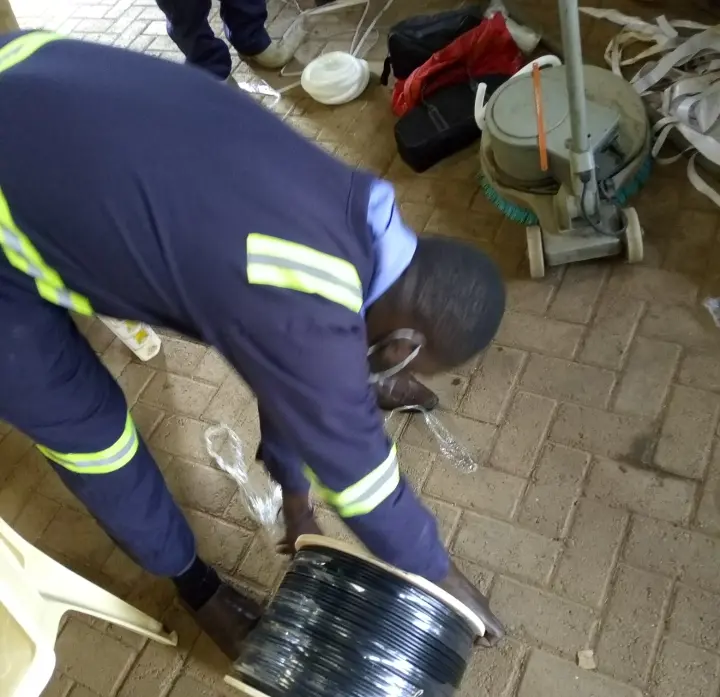
Cabling also needs proper protection and routing.
At Boardtac Solutions, the installation approach considers the complete CCTV system rather than treating the camera as an isolated piece of equipment.
This includes consideration of:
- Camera mounting.
- Cable routing.
- Cable protection.
- Network connectivity.
- Power requirements.
- Weather exposure.
- Camera accessibility.
- Maintenance requirements.
- Recording infrastructure.
- Monitoring.
- Future expansion.
The result should be an installation that is practical to operate and maintain.
CCTV Installation in Hospitals Must Respect Patient Privacy
Hospital CCTV requires an additional level of care.
Security is important, but patient dignity and privacy are equally important.
Cameras should be concentrated on appropriate security areas such as entrances, parking areas, external zones, security points, pharmacies, stores and other areas where surveillance is justified.
Cameras should not be casually positioned to capture sensitive clinical activities or areas where privacy could be compromised.
Healthcare facility guidance specifically emphasizes privacy when deciding CCTV locations.
This is another reason why professional CCTV planning is important.
The objective is not to put cameras everywhere.
The objective is to put the right cameras in the right places for the right security purpose.
CCTV Installation Standards That Matter to Boardtac Solutions
At Boardtac Solutions, we believe a professional CCTV installation should be judged by the quality of the final security outcome, not simply by the number of cameras installed.
Our approach focuses on several key principles.
1. Security-first design
We start with the security problem.
If a client has experienced theft, vandalism, unauthorized access or a blind spot, we identify where and how that problem is occurring before recommending the solution.
2. Strategic camera positioning
We position cameras according to the required field of view.
We do not simply install cameras where it is easiest to drill a hole.
3. Strong mounting
Where a wall, ceiling or existing structure is unsuitable, we can design suitable mounting structures for the required camera position.
The Nairobi hospital project is an example of this approach.
4. Blind-spot reduction
We look beyond individual camera views and consider how different cameras work together.
5. Image quality
The camera must provide useful footage for the intended purpose.
A wide overview and a detailed identification view are not necessarily the same requirement.
6. Day and night consideration
Outdoor CCTV must be evaluated under the actual lighting conditions in which the system will operate.
7. Proper cable management
Cabling is part of the installation.
Poor cable routing can create reliability, maintenance and physical-security problems.
8. Testing and commissioning
After installation, the system should be checked to ensure that cameras are recording correctly and that the intended areas are actually visible.
9. Future maintenance
A CCTV system should be installed with future servicing and maintenance in mind.
10. Professional presentation
A security installation should be neat, secure and appropriate for the environment in which it is installed.
For hospitals and corporate facilities, the CCTV system is part of the client’s overall security infrastructure. It should therefore reflect the same level of professionalism expected from the rest of the facility.
Why Hospitals Should Not Choose a CCTV Provider Based Only on Camera Price
Two companies can quote for the same number of cameras and produce completely different security results.
One provider may simply install cameras where requested.
Another may examine the property, identify the risks, redesign the coverage and recommend a more appropriate solution.
The difference becomes obvious when an incident occurs.
The question is not:
“Did we install CCTV?”
The more important question is:
“Will the CCTV provide useful evidence when we need it?”
That is the standard that should guide a hospital, business, school, apartment complex, warehouse or corporate facility when selecting a CCTV service provider.
Why Boardtac Solutions Is a Preferred CCTV Partner in Nairobi
Boardtac Solutions approaches CCTV as a complete security solution rather than simply a camera supply business.
Our work covers the practical requirements involved in designing, installing, improving and managing CCTV systems for organizations that require dependable surveillance.
From a small blind spot to a large multi-site CCTV environment, the objective remains the same.
Provide meaningful visibility where it matters.
Our experience includes working with organizations that require CCTV coverage across complex environments, including businesses with multiple sites and customers that need cameras integrated into centralized platforms.
We understand that every site is different.
A hospital gate has different requirements from a warehouse entrance.
A parking area has different requirements from an office reception.
A construction site has different requirements from a residential apartment complex.
The CCTV system should therefore be designed around the environment.
The Nairobi Hospital Gate Project Demonstrates Our Approach
The hospital project is a good example of why professional CCTV design matters.
The client had identified a security problem.
There was a blind spot around the outside gate and parking area.
Vehicles were vulnerable to vandalism.
Boardtac Solutions assessed the area and designed a CCTV solution around the actual security requirement.
Specialized cameras were selected.
CCTV metal stand posts were strategically positioned on either side of the gate.
The posts were welded to provide suitable and secure camera mounting positions.
The cameras were then positioned to improve visibility across the required sides of the gate and surrounding area.
The solution was therefore not simply about adding cameras.
It was about engineering the camera positions around the security risk.
That is the difference between installing CCTV and designing a CCTV security system.
Frequently Asked Questions About Hospital and Parking CCTV
Where should CCTV cameras be installed in a hospital?
Important areas can include vehicle entrances and exits, pedestrian entrances, parking areas, external perimeters, security points, loading areas, pharmacies, stores and other security-sensitive areas.
The final camera locations should be determined through a site-specific security assessment.
How many CCTV cameras does a hospital need?
There is no universal number.
The number depends on the size of the property, the number of entrances, parking areas, buildings, security risks, camera technology, required image detail and the desired level of coverage.
A professionally designed system may provide better security with fewer strategically positioned cameras than a poorly designed system with many cameras.
How do you eliminate CCTV blind spots?
Blind spots can be reduced through proper site surveys, strategic camera positioning, appropriate lenses, overlapping views, suitable mounting structures, adequate lighting and testing of the final camera views.
Should CCTV cameras be installed at the hospital gate?
Yes. Hospital gates are important surveillance points because they control the movement of vehicles and people into and out of the facility.
However, gate CCTV should be designed according to the actual security requirements of the entrance.
Should a hospital parking area have CCTV?
Yes. Parking areas are important security zones because vehicles, staff, patients and visitors may remain there for extended periods.
Parking CCTV should consider vehicle movement, pedestrian movement, lighting, blind spots and the level of detail required.
Is a wide-angle camera enough for a parking area?
Not always.
A wide-angle camera can provide a useful overview, but a separate camera may be required where detailed identification of people or vehicles is important.
Can CCTV cameras be installed on metal poles?
Yes.
Purpose-built metal poles or stands can provide suitable mounting positions where walls or existing structures are not appropriate.
The structure should be properly designed, securely installed and positioned according to the required camera view.
Does CCTV still work at night?
Yes, when the appropriate cameras and supporting lighting are selected.
Night-time performance should be considered during the design stage rather than discovered after installation.
What is more important: the camera or the installation?
Both matter.
A high-quality camera installed at the wrong angle can provide poor evidence.
Likewise, a professionally positioned camera cannot compensate for equipment that is unsuitable for the required application.
A successful CCTV system combines suitable equipment with proper design, installation, configuration and maintenance.
CCTV Security Is an Investment in Visibility
A hospital does not install CCTV simply because cameras look good on a security wall.
The purpose is to create visibility.
Visibility can help security teams understand what is happening.
It can provide evidence after an incident.
It can help identify movement around restricted areas.
It can help protect vehicles and property.
It can support investigations.
It can provide management with greater awareness of activity around the facility.
But these benefits depend heavily on how the system is designed.
A camera pointed at the wrong area does not solve a security problem.
A camera blocked by an obstruction does not provide useful coverage.
A camera affected by glare may produce poor evidence.
A camera installed without consideration of its mounting structure may become a maintenance problem.
A CCTV system should therefore be treated as an engineered security system.
Choose Boardtac Solutions for Professional CCTV Installation in Nairobi
If your hospital, company, office, warehouse, apartment complex, school, construction site or commercial property has a CCTV blind spot, the answer may not simply be to purchase another camera.
The right solution starts with understanding the security problem.
Boardtac Solutions can assess your CCTV environment, identify areas that require better coverage and recommend a practical CCTV solution based on the property’s actual requirements.
Whether you need CCTV installation at a hospital gate, parking surveillance, perimeter monitoring, vehicle entrance coverage, CCTV upgrades or a larger centralized surveillance solution, our focus is on delivering a system that is properly planned and professionally installed.
Do not wait until an incident exposes a CCTV blind spot.
Have your CCTV coverage assessed before the next security problem occurs.
Contact Boardtac Solutions
For CCTV Installation and Security Solutions in Nairobi and Surrounding Areas:
Call: 011-367-0045
Email: support@boardtac.co.ke
Website: Boardtac Solutions
Request a Consultation or Quotation:
Contact Boardtac Solutions
Boardtac Solutions — Professional CCTV Design, Installation and Security Solutions.