4G Solar CCTV Cameras in Kenya: When Cheap Becomes Expensive
4G solar CCTV cameras have become increasingly popular in Kenya. They offer an attractive solution for farms, rural homes, construction sites, gates, ranches, businesses and properties where electricity or Wi-Fi may not be readily available.
But at Boardtac Solutions, we have recently received calls from customers who are extremely disappointed after buying and installing low-cost 4G solar CCTV cameras from different shops and technicians in Nairobi.
These customers are not calling us because they simply want a new camera. They are calling because they have already spent money, experienced repeated failures and are struggling to get a proper solution.
One common complaint sounds like this: “My camera is draining the battery. Even after replacing it with a new battery, it doesn’t charge beyond 29% or 31%. I don’t know whether the replacement battery is faulty or the camera itself has a problem.”
Another customer had a solar camera installed in Laikipia. The camera repeatedly goes off. Whenever the customer contacts the seller, they are advised to remove the camera, manually charge the battery and put it back on the pole. The camera works for a few days and then dies again.
Eventually, the seller suggests another battery or another solar panel.
When that also fails, the customer is told to bring the equipment back to Nairobi.
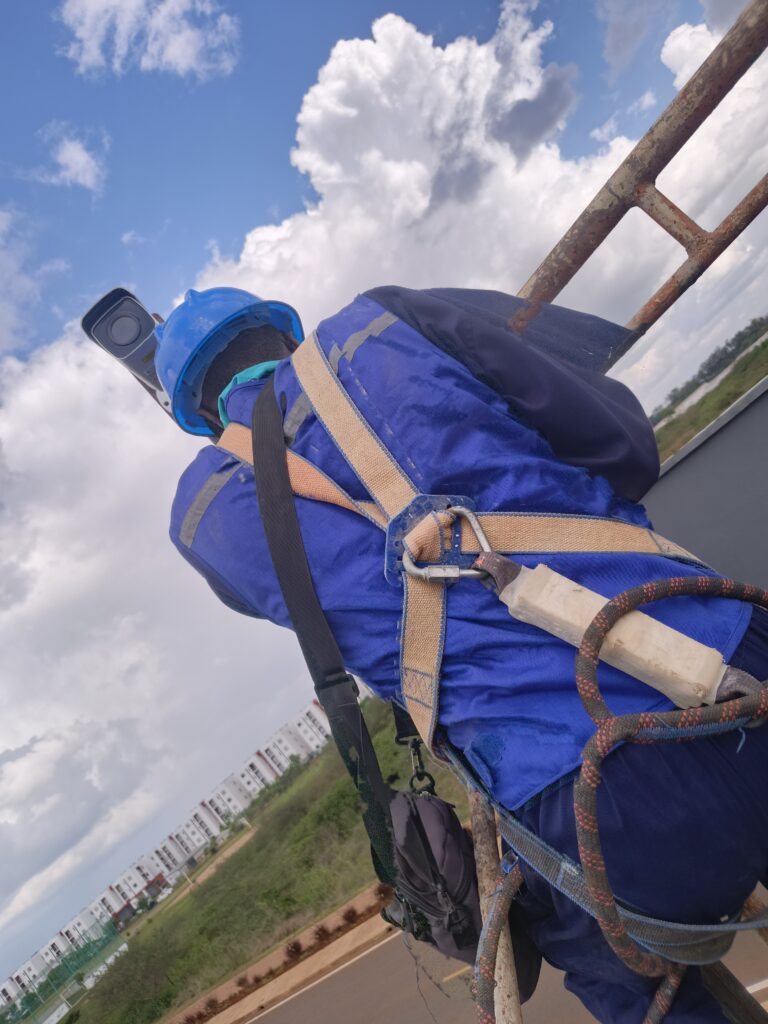
The problem is that the customer may not even be living at the property. They could be working in Mombasa, Meru, Nairobi or another part of the country. Now they are expected to travel back home, remove a camera mounted on a pole and transport it all the way to Nairobi for another round of trial and error.
This is where the real cost of a cheap CCTV system begins to appear.
The problem is not always the battery.
A battery that keeps going flat does not automatically mean the battery is faulty.
The camera may be consuming more power than the solar panel can replace. The solar panel could be undersized, poorly positioned or not receiving enough direct sunlight. The charging circuit could have a problem. The battery-management system could be faulty. The camera could have unusually high power consumption. The 4G modem could be working harder because of poor network conditions. Motion detection could be triggering the camera excessively. Night vision, spotlights, PTZ movement and frequent video transmission can also increase power consumption.
Replacing the battery without checking these things is simply guessing.
When troubleshooting becomes guesswork.
This is one of the biggest concerns we have seen from customers who have contacted Boardtac Solutions.
The process becomes something like this.
Battery is suspected.
Battery is replaced.
Camera works temporarily.
Camera dies again.
Solar panel is suspected.
Solar panel is replaced.
Camera works temporarily.
Camera dies again.
Another battery is suggested.
The problem returns.
Finally, the customer is asked to take the camera to Nairobi.
At this point, the customer has spent money but still does not know what is actually wrong.
Professional troubleshooting should be different.
The objective should be to identify the root cause before replacing components.
A solar CCTV system is more than a camera and a panel.
A reliable solar CCTV system is an energy system.
The solar panel generates power. The charging circuit manages that power. The battery stores it. The camera consumes it. The 4G modem uses additional energy to communicate with the network. At night, infrared illumination or white-light LEDs consume more power. PTZ movement and frequent motion events can further increase consumption.
All these components have to work together.
If the camera consumes more energy than the solar system can replenish, the battery will gradually decline until the camera goes offline.
Installing a bigger battery alone may only delay the problem.
Installing another solar panel without understanding the charging system may also fail to solve it.
Why does manually charging the battery appear to fix the problem?
Manually charging the battery can make a dead camera come back to life.
But if the camera dies again after three days, the manual charging has not fixed anything.
It has only temporarily restored the energy that the system is failing to generate or manage properly.
The correct question should be:
“Why did the battery become empty in the first place?”
That requires testing.
What should a technician check?
Before replacing another battery or solar panel, the system should be properly assessed.
The technician should check the solar panel output under suitable sunlight. The charging voltage should be checked. The battery voltage and condition should be assessed. The camera’s power consumption should be considered. The 4G signal should be checked. Motion detection and recording settings should be reviewed. The solar panel’s position and exposure to sunlight should be inspected. Connections and cables should also be checked.
The goal is to determine whether the problem is coming from the solar panel, battery, charging circuit, camera, configuration, network or installation.
Only after identifying the likely cause should components be replaced.
Remote CCTV installations need proper after-sales support.
A camera installed in Nairobi is relatively easy to access.
A camera installed on a farm in Laikipia is different.
If the equipment fails, someone may have to travel hundreds of kilometres. The customer may have to leave work. Someone has to climb the pole. The camera has to be removed. Transport has to be arranged. The equipment has to be taken to Nairobi. Then it may be tested, another component replaced and eventually returned to the site.
If the same fault happens again, the entire process starts over.
That is not just a technical problem.
It becomes a customer service problem and a financial problem.
The hidden cost of a KSh 5,000–12,000 camera.
There are many generic 4G solar CCTV cameras available in the Kenyan market at relatively low prices.
At first, the price can be very attractive.
But customers should look beyond the purchase price.
A cheap camera can become expensive when you add repeated battery replacements, solar panel replacements, transport, technician visits, dismantling, reinstallation, data costs, downtime and the loss of confidence in the system.
The customer may have saved money when buying the camera but spent much more trying to keep it operational.
That is why the saying “cheap is expensive” can be very real when purchasing security equipment.
The problem is not simply that a camera is cheap.
There are affordable CCTV products that can work well.
The real concern is buying an unknown or poorly supported product without understanding its specifications, power requirements, battery quality, charging system, firmware, spare parts availability and after-sales support.
Two cameras can look almost identical from the outside and still have completely different internal components and reliability.
A product can have impressive marketing features but still have poor power management or inadequate support.
What should customers ask before buying a 4G solar CCTV camera?
Don’t only ask, “How much is the camera?”
Ask who manufactures it. Ask for the exact model. Ask about the battery capacity. Ask about the solar panel rating. Ask about expected power consumption. Ask how the system behaves during several cloudy days. Ask what happens if the battery goes completely flat. Ask whether replacement batteries and other parts are available. Ask who will provide technical support when the camera fails. Ask what the warranty covers. Most importantly, ask whether the installer will provide support if the camera is installed hundreds of kilometres away.
A good supplier should be able to explain these things clearly.
At Boardtac Solutions, we are seeing the other side of the story.
The customers who contact us are often already frustrated.
They have purchased the equipment. They have paid for installation. They have contacted the seller several times. Batteries have been replaced. Solar panels have been changed. The camera has been removed and reinstalled.
Yet the problem keeps coming back.
They eventually contact Boardtac Solutions because they want someone to look at the problem from a technical perspective instead of simply guessing which component to replace next.
And sometimes, the difficult part is that we cannot responsibly guarantee a repair when we don’t know the actual manufacturer, internal design, battery specifications, charging system or availability of genuine replacement parts.
That is an important lesson for both customers and technicians.
Don’t choose a security system based only on the price.
A CCTV camera is not just a gadget.
It is a security system that you depend on when something happens.
For remote locations especially, reliability and after-sales support should be part of the buying decision.
The cheapest quotation may not be the cheapest solution in the long run.
Before buying a 4G solar CCTV camera, ask yourself one simple question.
“If this camera stops working six months from now, who will actually help me?”
Because the real cost of CCTV is not only what you pay when the camera is installed.
It is also what you spend keeping it working.
Cheap can be expensive. Reliable security is an investment.