CCTV System Design in Large Residential Estates: Why Network, Storage, and Camera Selection Must Be Engineered Not Assumed.
At Boardtac Solutions, we have learned through real-world installations that CCTV design for large residential estates is rarely a “plug-and-play” exercise. It is an engineering process that must balance coverage, network architecture, bandwidth, storage, power distribution, and long-term scalability.
Many project challenges begin when expectations are set around high-performance cameras and compact infrastructure, without fully accounting for how these systems behave in real environments.
This article explains the key technical considerations that determine whether a CCTV system will be reliable, scalable, and cost-effective especially in estates with long distances, multiple entry points, and high-security requirements.
1. Estate Size Directly Impacts Network Design.
In a typical medium-to-large residential estate, distances between the main control point (NVR location) and the furthest cameras can easily exceed 300–400 meters.
This immediately introduces a fundamental limitation.
- Standard Cat 6 Ethernet has a maximum reliable transmission distance of ~100 meters per segment.
To overcome this, designs must incorporate.
- Distributed PoE switching architecture.
- Strategic network segmentation.
- Possible fiber backbone uplinks for long distances.
- Proper power planning for each network node.
Without these considerations, systems may appear functional during installation but later suffer from.
- Packet loss.
- Camera disconnections.
- Reduced video quality.
- Intermittent recording failures.
A CCTV system is only as strong as its network backbone.
2. High-End PTZ Cameras Require More Than Just Bandwidth.
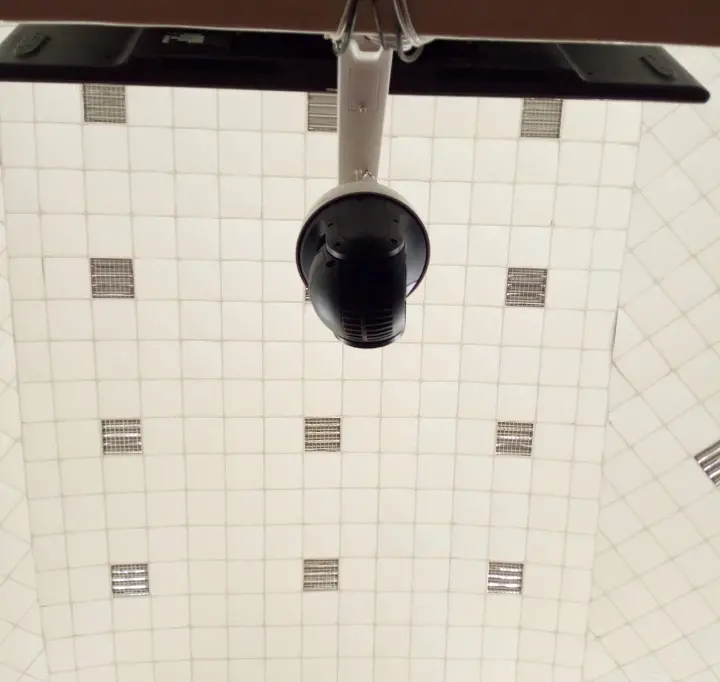
Modern estates increasingly request high-performance PTZ cameras such as 4MP models with 25× optical zoom for.
- Gate monitoring.
- Perimeter tracking.
- Incident zoom-in capability.
- Wide-area surveillance control.
While these cameras offer excellent visibility, they come with two major technical demands.
a) Higher Power Requirements.
PTZ cameras require stable PoE power, especially when.
- Moving continuously.
- Activating IR night vision.
- Using motorized zoom functions.
b) Higher Bandwidth Consumption.
Unlike fixed cameras, PTZ units.
- Stream higher-detail video.
- Often support dual streams.
- Require stable bitrate allocation for smooth control.
When deployed in large numbers, they significantly increase network load and must be properly balanced within switch capacity and uplink design.
3. Storage Is Always Underestimated in CCTV Projects.
One of the most common design gaps in CCTV proposals is storage sizing.
For example, a system consisting of.
- 10 × 4MP PTZ cameras.
- 12 × 4MP bullet cameras.
Even with efficient compression like H.265, generates continuous high-volume video data.
Key reality.
An 8TB surveillance-grade NVR storage can only provide approximately.
- 4 to 5 days of retention (depending on frame rate, motion settings, and scene complexity).
This becomes critical in estates where.
- Investigations may require 7–30 days of footage.
- Incident review depends on historical video.
- Insurance or legal verification is required.
Proper design may require.
- Larger storage arrays.
- RAID-based NVR systems.
- Scalable NAS integration.
- Motion-based recording optimization.
4. The Hidden Cost Factor: High-Spec PTZ Cameras.
There is often a mismatch between requested specifications and actual market pricing.
High-quality 4MP 25× PTZ cameras from reputable manufacturers such as.
- .
- .
Typically cost in the range of.
- KES 57,000 to 60,000 per unit (excluding VAT).
When multiplied across multiple points in an estate, PTZ cameras alone can represent a significant portion of the entire project budget.
This is why early design alignment is critical — not just to reduce cost surprises, but to ensure performance expectations match financial planning.
5. Power Distribution and PoE Architecture Must Be Engineered Carefully.
Large estate deployments often rely on PoE switches distributed across multiple points.
However, this introduces key engineering requirements.
- Each PoE switch must be properly sized for camera load.
- Power redundancy should be considered (UPS backup).
- Surge and lightning protection must be installed.
- Cable distances must remain within specification limits.
A weak power or switching design can lead to.
- Random camera shutdowns.
- System instability during peak load.
- Reduced lifespan of equipment.
6. Why Early Assumptions Create Project Risk.
One of the biggest risks in CCTV projects is starting installation based on assumptions that are not fully validated on site.
Common assumptions include.
- “Cat 6 alone is enough for the entire estate”.
- “8TB storage is sufficient for all cameras”.
- “PTZ cameras behave like standard fixed cameras”.
- “Network load will always remain low”.
In reality, each of these depends on.
- Layout distance.
- Camera configuration.
- Recording settings.
- User expectations for retention.
- Future expansion plans.
Once procurement and installation begin, correcting these assumptions becomes significantly more expensive.
7. Boardtac Solutions Approach: Design Before Deployment.
At Boardtac Solutions, we prioritize engineering validation before quotation finalization. This includes.
- On-site technical surveys.
- Network distance mapping.
- Load estimation for all cameras.
- Storage retention modeling.
- Power and redundancy planning.
- Scalability assessment for future expansion.
Our goal is simple. Deliver systems that work reliably in real conditions, not just on paper.
A CCTV system is not just a collection of cameras it is a complete infrastructure ecosystem.
For large residential estates, success depends on.
- Proper network architecture.
- Correct camera-to-storage balance.
- Realistic power and PoE planning.
- Accurate cost-performance alignment.
When these factors are engineered correctly from the beginning, the result is a system that is stable, scalable, and capable of delivering true security value over time.
At Boardtac Solutions, we believe that good security design is not about cutting corners it is about building systems that perform exactly as expected when they are needed most.